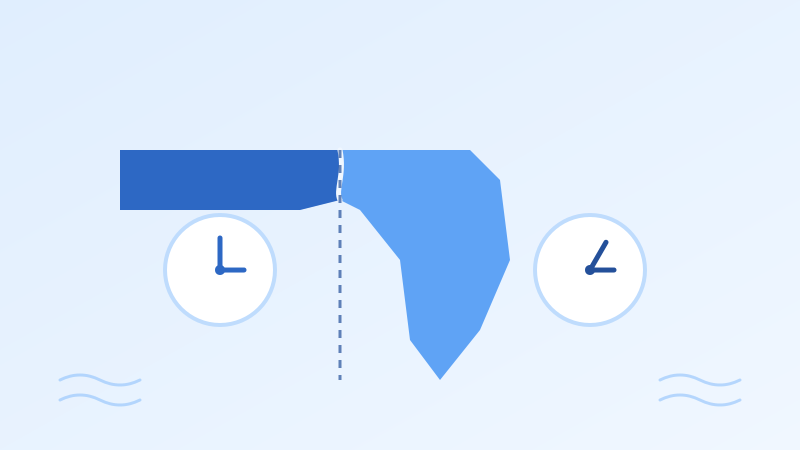
Florida is shaped like a straight-ish peninsula, which makes it easy to assume the whole state runs on one clock. It doesn't. Florida is split between Eastern and Central time, and the dividing line is a river most people have never heard of.
The Apalachicola River is the boundary
Most of Florida — including Miami, Orlando, Tampa, and Jacksonville — is in the Eastern Time Zone. But the westernmost stretch of the Florida Panhandle, including Pensacola and the area around it, is in the Central Time Zone, an hour behind the rest of the state. The dividing line roughly follows the Apalachicola River: everything east of it runs on Eastern Time, everything west of it runs on Central.
Why the line falls there
Florida's time zone boundary isn't arbitrary — like most US time zone lines that don't follow state borders, it reflects historical economic and social ties rather than geographic logic. The Panhandle's westernmost communities have traditionally had closer ties to Alabama and the broader Gulf Coast region (which run on Central Time) than to the rest of Florida, so the boundary was drawn to match those regional connections rather than to bisect the state evenly.
What this means in practice
If you're calling or scheduling with someone in Pensacola while thinking of them as being on "Florida time" the same as Miami, you'll be an hour off. A meeting set for 2pm Eastern in Orlando is 1pm Central in Pensacola — despite both cities being in the same state.
This also matters for travel: driving along I-10 through the Panhandle means crossing a time zone line without crossing a state border, similar to the experience of driving across Texas or Indiana. It's easy to miss if you're not specifically watching for it, since there's no dramatic geographic marker — just a sign noting the time zone change.
It shows up in everyday scheduling too. Local TV listings, store hours, and event start times in the Central-time portion of the Panhandle are printed for Central Time — so a "7pm" showtime in Pensacola is genuinely an hour earlier by clock time than a "7pm" showtime in Tampa, even though both are described the same way on a flyer. Businesses that operate across both halves of the state (a statewide retail chain, for instance) generally have to explicitly label hours by time zone in their Panhandle locations to avoid customer confusion.
Florida isn't unique here
Florida is one of 14 US states split across two time zones — a longer list than most people expect, also including Texas, Indiana, Kentucky, Michigan, Tennessee, Kansas, Nebraska, North Dakota, South Dakota, Oregon, Idaho, Nevada, and Alaska. In most of these cases, the line follows historical trade and travel patterns rather than a clean geographic split.
Because a state name alone doesn't tell you which time zone a specific city is actually in, it's worth checking by city rather than assuming — the time zone converter resolves this per city, so Pensacola and Miami never get treated as if they share a clock.
Frequently asked questions
Which part of Florida is on Central Time?
The western Florida Panhandle — ten counties including Escambia, Santa Rosa, Okaloosa, Walton and Bay, so Pensacola, Destin and Panama City — runs on Central Time (UTC−6/−5), an hour behind the rest of the state. Everything east of the line, including Miami, Orlando, Tampa and Jacksonville, is Eastern.
What's the time difference between Pensacola and Miami?
One hour. Pensacola is on Central Time and Miami is on Eastern, so a meeting set for 2pm Eastern in Orlando is 1pm Central in Pensacola — despite both cities being in the same state. Treat Pensacola as being on “Florida time” like Miami and you will be an hour off.
Why does Florida's time zone line follow the Apalachicola River?
It roughly follows the river in its lower stretch and county lines further north. The boundary reflects historical economic and social ties rather than geographic logic: the westernmost Panhandle communities have long had closer connections to Alabama and the wider Gulf Coast, which run on Central Time.
How many US states have two time zones?
Florida is one of fourteen, counting Alaska's Aleutian split. The others are Texas, Indiana, Kentucky, Michigan, Tennessee, Kansas, Nebraska, North Dakota, South Dakota, Oregon, Idaho, Nevada and Alaska. In most cases the line follows historical trade and travel patterns rather than a clean geographic split.